By Analyst Team · Updated 2026-08-08 · 13 min read
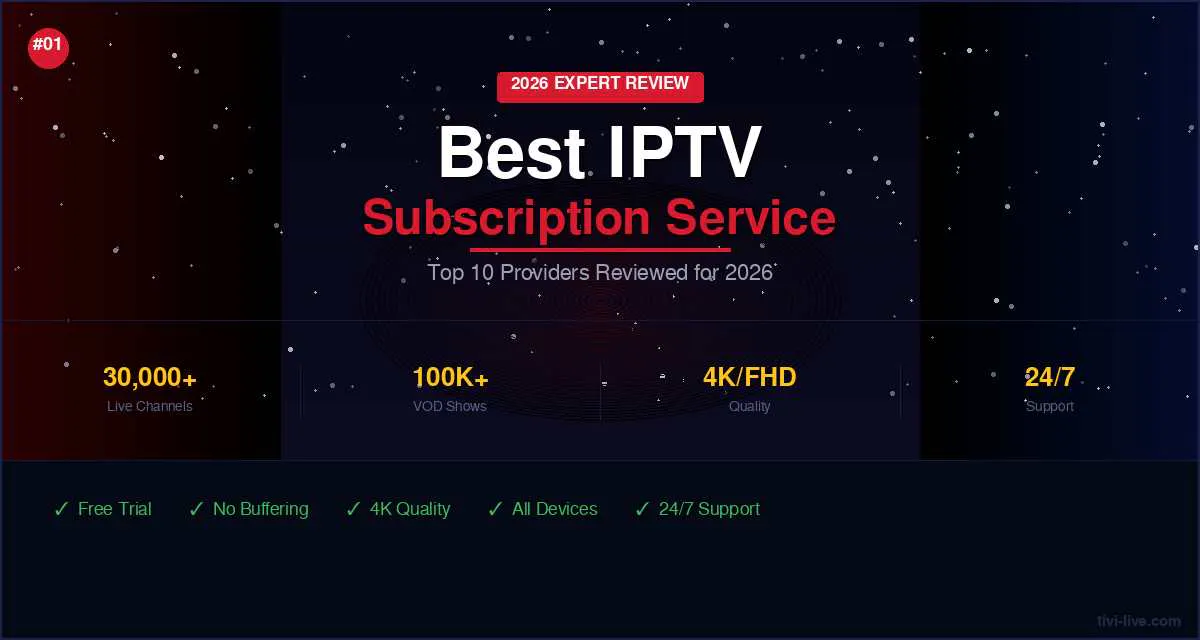
IPTV stands for Internet Protocol Television. Instead of receiving channels through a cable line, satellite dish, or antenna, you stream them live over your internet connection. The technology splits video into small data packets, sends them through your broadband, and your device — a smart TV, Firestick, or phone — reassembles them into a smooth picture. It is the same principle behind Netflix and YouTube, but applied to live TV, sports, and international channels.
This guide answers "how does IPTV work" in plain English, compares it to cable and popular streaming apps, and gives you a clear, step-by-step setup path. No jargon is left unexplained. The image above shows a typical IPTV home screen on a smart TV, with a live sports broadcast and an on-screen guide running over a standard broadband connection. Whether you are researching "how does IPTV work on smart TV" or wondering if IPTV can replace cable, you will find a direct answer in the next few minutes.
The shift from cable to internet TV is not a passing trend; it is a fundamental re-platforming of the television industry. By the end of this complete guide, you will know exactly what IPTV is, how it works on smart TVs and Firesticks, what costs to expect, and how to choose a service that will not disappear after your first payment.
LIMITED TIME AVAILABILITY
Unlock Full how does iptv work Access
Secure special promotional rates instantly before the window closes. Lock in your pricing model today before plans return to standard regional metrics.
What Is IPTV? A Simple Definition
IPTV is a system where television services are delivered using the Internet Protocol suite over a packet-switched network — the internet. In everyday terms, you do not need a dish, a cable box, or an antenna. All you need is broadband and a device with an IPTV app installed. The content arrives through the same digital pipe you use for web browsing, video calls, and online gaming.
Most IPTV subscriptions include three content formats:
- Live TV: channels streamed in real time, just like broadcast television.
- Video on Demand (VOD): movies and series you can watch whenever you want.
- Time-Shifted TV: catch-up and start-over features that let you watch a live show an hour or a day late.
You will also hear a few technical terms. An M3U file is simply a playlist of channel links. The EPG is the digital program guide that shows what is airing now and next. Xtream Codes is an authentication method that apps use to fetch the channel list and EPG from a provider's server. Understanding these three terms makes the setup process much less intimidating.
Modern providers bundle live TV, VOD, and catch-up features into one app with an electronic program guide that mirrors the familiar cable channel grid. This is also where searches for the "best IPTV service for live sports" usually begin, because premium sports packages are the number one reason people cut the cable cord.
Why People Are Switching: The Real Benefits
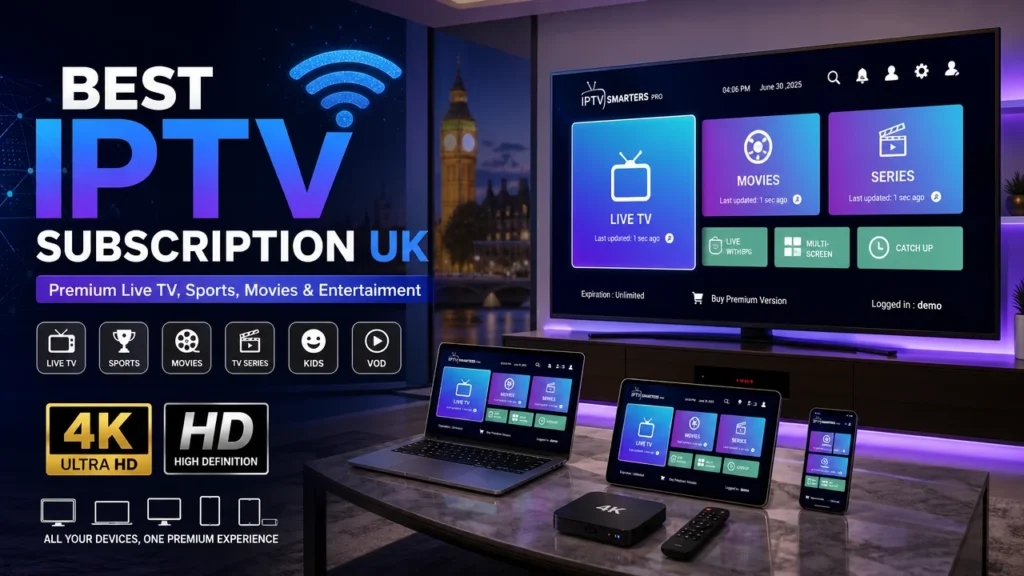
The biggest benefit is choice. A single IPTV subscription can open up ten thousand channels from every continent, which no cable company can match. For sports fans, the best IPTV service for live sports delivers premium leagues, pay-per-view events, and stadium feeds in Full HD or 4K, exactly as shown above.
The practical advantages go further:
- Cost: most plans sit between $5 and $20 per month, compared to $100+ for cable.
- Multi-device access: watch on a smart TV, Firestick, phone, tablet, or laptop — often simultaneously.
- No contracts: monthly or quarterly plans without lock-in, cancellation fees, or equipment rental.
- International channels: ideal for expats who want home-country news, sports, and entertainment.
- Time-shifted viewing: pause, rewind, or record live broadcasts even if you forget to set a DVR.
Unlock complete high-definition information and priority access packs.
Claim This Special Offer for how does iptv work →How Does IPTV Work? The 6-Step Process
Under the hood, IPTV works in six steps. Each one happens in the background, usually within five seconds of pressing play.
- Capture: the provider receives channels from satellite feeds, local antennas, or fiber sources.
- Encoding: raw video is compressed into a digital format such as H.264 or H.265 to reduce bandwidth.
- Storage: live streams are held on media servers; VOD content sits in storage arrays ready to be fetched.
- Distribution: the stream is routed through a content delivery network (CDN) or a cluster of servers close to your location.
- Transmission: your device requests the channel through a playlist file (M3U) or portal URL, and the server sends video over HTTP or RTSP.
- Playback: the IPTV app decodes the packets and renders them on your screen.
If you are using a smart TV, the app handles all the heavy lifting. On a Firestick, the same process applies after you sideload an IPTV player. Because the device itself does the decoding, older hardware may struggle with 4K; a recent Firestick 4K Max or an Android TV box with a strong processor delivers the best experience.
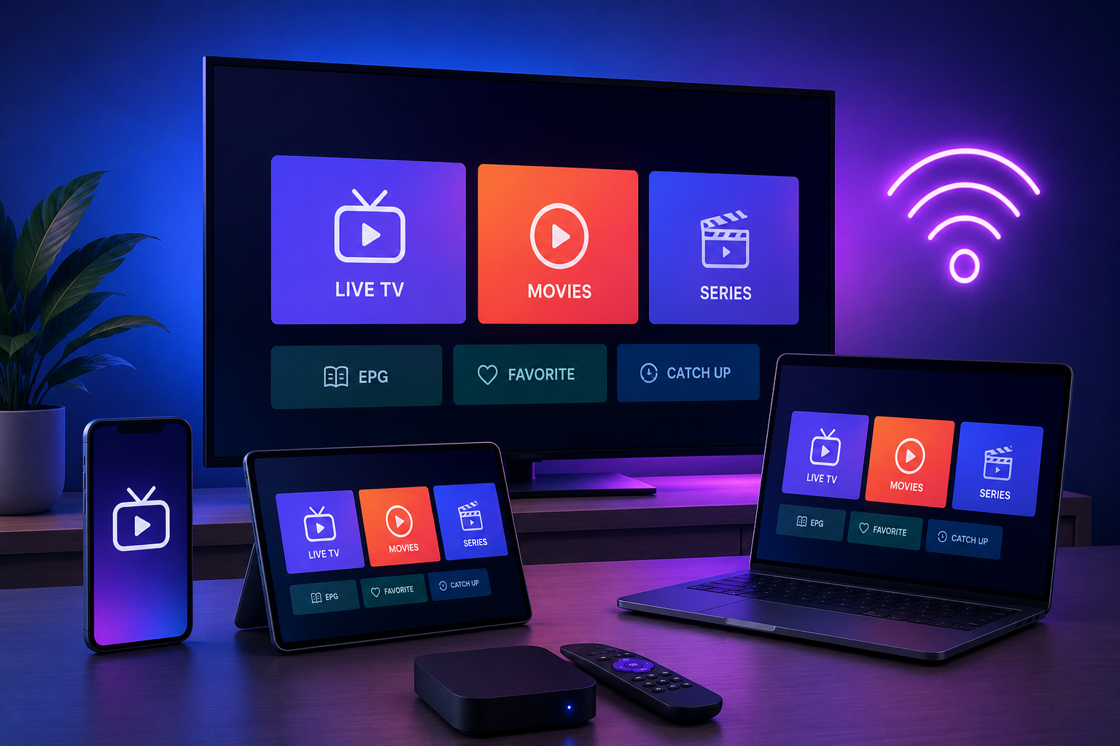
The illustration below shows how the same internet protocol carries a single channel simultaneously to a smart TV, Firestick, and mobile phone. This is why IPTV setup is so much more flexible than fixed cable infrastructure.
Honest Limitations and How to Handle Them
Let us be honest: IPTV is not magic. The quality of your experience depends heavily on your connection speed and the provider you pick.
Your internet connection is everything. A stable 25 Mbps connection is the practical minimum for HD; 4K streams need 50 Mbps or more. Use a wired Ethernet connection whenever possible, or make sure your Wi-Fi router is modern and close to the device.
Buffering happens. During peak evening hours, even good servers can slow down. The fix is usually a combination of lowering the video output, updating the player, or connecting through a VPN if your ISP throttles streaming traffic. The complete IPTV buffering fix guide in the FAQ below covers this in more detail.
Not every provider is trustworthy. The industry has a reputation problem because low-quality resellers appear and disappear overnight. Stick to providers with trial offers, transparent pricing, and genuine user feedback on forums like Reddit. When the provider's support team disappears, your subscription is effectively gone too — so the "where to buy a reliable IPTV subscription" question matters more than any feature list.
Legal gray areas exist. IPTV technology is legal, but providers that broadcast content without distribution rights are not. Choosing a service that is transparent about licensing keeps you on the safe side.
- Costs a fraction of cable
- Thousands of global channels
- Works on TV, Firestick, mobile
- No long-term contracts
- Best sports coverage per dollar
- Requires strong stable internet
- Reliability varies by provider
- Possible buffering at peak hours
- Legal status depends on licensing
- Setup needs basic tech skills
IPTV vs Cable vs Satellite vs Streaming Apps
To make the choice simple, here is a side-by-side comparison of the four main ways to watch television today.
| Feature | IPTV | Cable | Satellite | Streaming Apps |
|---|---|---|---|---|
| Monthly cost | $5 – $20 | $50 – $150 | $60 – $130 | $8 – $20 |
| Channel variety | 10,000+ | 200 – 300 | 200 – 300 | VOD only |
| Live sports | Excellent (with solid provider) | Good | Good | Limited |
| Device support | Smart TV, Firestick, mobile | TV only | TV + DVR | Many devices |
| Contract | No | 12 – 24 months | 12 – 24 months | No |
| Internet required | Yes | No | No | Yes |
| Setup difficulty | Moderate | Professional | Professional | Easy |
| Reliability | Depends on provider | Very high | High | Very high |
Looking at that table, "IPTV vs cable which is better" comes down to priorities. If price, choice, and flexibility matter most, IPTV wins. If you never want to think about buffering or setup again, cable is still the easiest option — but it is also the most expensive.
Who Should Buy an IPTV Subscription?
IPTV is not for everyone. These are the user profiles that get the most value from a subscription:
- Cord-cutters: people currently paying $100+ per month for channels they barely watch.
- Sports fans: if your priority is the best IPTV service for live sports — leagues, PPV, multiple camera angles — IPTV delivers more for less.
- Expats and internationals: access home-country channels that local cable cannot offer.
- Travelers: a Firestick or mobile IPTV app travels well and can be used on hotel Wi-Fi.
- Tech enthusiasts: people who enjoy configuring Firesticks, apps, VPNs, and network settings to cut costs.
How to Set Up IPTV: 7 Practical Steps
Ready to try IPTV? Here is the exact workflow we recommend when testing a new provider.
- Choose a provider with a trial. Look at IPTV review Reddit 2025 discussions and tech forums to find services with real user history and honest feedback.
- Buy a subscription and make sure you receive either an M3U playlist URL or Xtream Codes (portal address, username, password).
- Install an IPTV player on your device. IPTV Smarters, TiviMate, and IProTV are solid choices on Firestick and Android TV.
- Enable sideloading on Firestick: go to Settings > My Fire TV > Developer Options > turn on Apps from Unknown Sources. Then install Downloader and sideload the player.
- Enter your credentials in the player: add the M3U URL or Xtream portal details.
- Load the EPG so the interface shows program names, times, and channel logos.
- Test during peak hours. Watch a live sports match in the evening; if you see buffering, apply the buffering fixes from the FAQ below or try a VPN.
A quick note on VPNs: if your ISP is known to throttle streaming, subscribe to a VPN first and enable it before opening the IPTV app. Routes tested from a VPN server often produce more stable streams during prime-time hours.
Final Subscription Window:
Main Offer Today →Affiliate Disclosure: Clicking this secure link verified by our network supports our team through standard partnership terms at zero extra cost to your invoice.
Frequently Asked Questions
1. How does IPTV work on smart TV?
Smart TVs with Android TV, webOS, or Fire TV OS can run IPTV apps directly. You install an app such as IPTV Smarters or TiviMate, enter your M3U URL or Xtream portal credentials, and the app pulls the channel list from the provider's server. No external box is required because the TV decodes the video internally. For the smoothest performance, use a wired Ethernet connection and a TV that supports the 4K codec used by your provider.
2. What is the best IPTV service for live sports?
The best IPTV service for live sports combines dedicated sports channel packages, multiple backup streams for major matches, and low-latency servers in your region. Look for providers that include premium sports networks, 4K/UHD broadcast options, and an EPG that reliably lists fixtures. Reading recent community reviews, especially IPTV review Reddit threads from 2025, helps you identify which services stay stable during peak game times.
3. How to set up IPTV on Firestick?
On Firestick, open Settings > My Fire TV > Developer Options and enable Apps from Unknown Sources. Install the Downloader app from the Amazon store, use it to download an IPTV player like IPTV Smarters or TiviMate, then open the app and add your M3U URL or Xtream Codes. The channel list and EPG usually load within a minute. This is the same method used in most how-to-set-up-iptv-on-firestick tutorials, and it takes about five minutes.
4. IPTV vs cable — which is better?
IPTV wins on price, channel variety, and device flexibility. Cable wins on plug-and-play reliability and clear legal status. If your internet connection delivers at least 50 Mbps consistently, IPTV offers dramatically better value — thousands of channels for under $20 per month. If you prefer zero setup, a guaranteed signal, and professional support, traditional cable still works but is becoming harder to justify financially.
5. Is IPTV legal in the US?
IPTV technology is completely legal in the United States. The legality depends on whether the provider holds the proper rights for the channels it distributes. Services like Hulu Live and YouTube TV are IPTV services with proper licensing. Unlicensed providers stream content without permission, which violates copyright law. The safest approach is to choose a reputable provider with transparent terms and positive community reviews.
6. Where to buy a reliable IPTV subscription?
Avoid random ads and social media promotions. Instead, look at community recommendations, search for IPTV review Reddit 2025 threads, and request a trial before paying. A reliable provider typically offers a 24-hour or 7-day trial, multiple simultaneous connections, a polished EPG, and responsive support. Established providers with thousands of verified user reviews are far safer than brand-new sites with no history.
7. IPTV buffering fix guide — why does it buffer and how do I fix it?
Buffering usually comes from your network, not the provider. Restart your router, prefer Ethernet over Wi-Fi, and close background applications. Update your IPTV player to the latest version. Try lowering the output resolution from 4K to 1080p. If the issue persists, connect through a VPN to bypass ISP throttling, especially during peak evening streaming hours.
8. IPTV review Reddit 2025 — what do real users say?
Reddit's IPTV community consistently warns against paid ads and spam resellers. Users recommend testing trials first, checking channel stability across different devices, and avoiding services that refuse to provide clear account details. The most praised providers in 2025 are those with dedicated apps, stable 4K sports streams, fast EPG loading, and support teams that respond within hours. Pairing a subscription with a VPN is also the standard advice for users whose ISPs throttle streaming.
Final Verdict: Is IPTV Worth It in 2026?
So, how does IPTV work? It delivers live TV and on-demand video over the internet, giving you a flexible, affordable alternative to cable and satellite. The experience depends on two things: your broadband line and your provider. With a stable connection and a subscription from a service that offers trials and transparent support, IPTV can replace a $150 cable bill for under $20 a month.
Start with a free or low-cost trial. Test it on a Firestick or smart TV during a live sports event. If the picture stays steady and the channel list looks reliable, you have found your long-term solution. If you want a recommendation based on our testing, use the offer links on this page to compare current plans and lock in promotional pricing while it lasts.